By: Rev. Onyemegbulem Brendan
Introduction:
There is a kind of silence that betrays, and there is one that listens; there is a kind of silence that is not passive, not indifferent, but profoundly alive. This kind does not withdraw but gathers, orders, and gives weight to presence. It is this latter form, better described as interior quietude, that shaped the life and priesthood of Rev. Fr. Ethelbert Uwadoka. In his life, one finds a silence that speaks without utterance, that forms without noise. It is the silence that becomes strength.
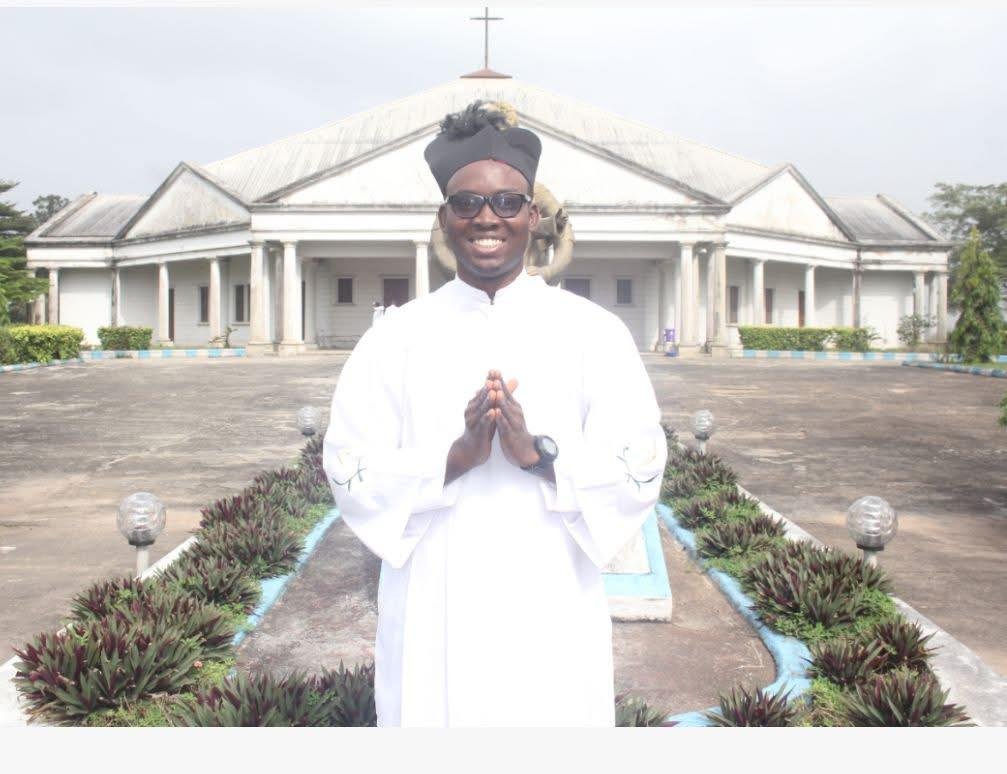
The 17th day of September, 2025, is not merely a date inscribed in the calendar of my memory; it is rather a quiet threshold of a journey that unfolds into one of the most profound encounters of my priestly formation. It was on that day that I packed into St. Paul’s Parish, Egbelu Umuhu, to begin my internship under Rev. Fr. Ethelbert Uwadoka. Barely six months later, on March 15, 2026, I was ordained a deacon under his gentle tutelage. Five days after, in the early hours of March 20, he passed quietly into eternity without warning, without struggle, without spectacle. His life ended as it was lived: in serene stillness. Therefore, to write about him is not merely to recount a biography but to enter into a deeper reflection on the nature of the priesthood itself. His life compels us to ask: Can quietude be strength? How can silence be a form of pastoral power? These and many more will shape this writing as this writing tries to uncover the silent personality of Fr. Uwadoka.
Quietude as Strength: A Theological Reconsideration
Quietude, in its theological sense, is not mere external silence but an interior disposition of stillness that renders the human person receptive to divine self-communication. As Josef Pieper explains, true silence is a “receptive stillness” that allows reality and ultimately God to disclose itself (Pieper, Leisure: The Basis of Culture, 1952). This understanding finds assistance with the biblical notion of דְּמָמָה (demāmāh, “deep silence” or “stillness”) in 1 Kings 19:12, where Elijah encounters God not in dramatic manifestations but in a “still small voice,” indicating that divine presence is mediated through quiet interiority (1 Kgs 19:12).
The New Testament theology deepens this through the mystery of Christ’s κένωσις (kenōsis, “self-emptying”), wherein divine omnipotence is revealed in humility and hiddenness (Phil. 2:7). As Hans Urs von Balthasar argues, God’s glory is paradoxically manifested in concealment rather than spectacle (The Glory of the Lord, 1982). Patristic theology further refines this insight through the concept of ἡσυχία (hesychia, “inner stillness” or “silence”). Evagrius Ponticus teaches that silence purifies the νοῦς (nous, “mind” or “intellect”), enabling ascent toward θεωρία (theoria, “contemplation of God”) (Evagrius, Praktikos 1972, 18). Similarly, John Cassian emphasizes that interior quiet orders the passions toward charity (Conferences Vol. 11, 293). This tradition finds continuity in magisterial teaching: Pope Benedict XVI insists in Deus Caritas Est that authentic Christian action flows from contemplative encounter (DCE, no. 7), while Verbum Domini highlights silence as essential for hearing the Word (VD, no. 66). In this wise, quietude emerges as a theological locus of divine-human encounters. It is not passivity but participation in God’s self-giving life, wherein God’s presence transforms and sustains authentic Christian existence. Apart from this theology, philosophy has a space reserved for understanding the dynamism of silence.
The Philosophy of Silence: Being Before Doing
The philosophical insight of silence is seen in Martin Heidegger, who argues that authentic existence (Dasein) emerges not in noise but in attentive listening, where silence becomes the condition for encountering Being (Sein und Zeit, 1927). Silence, therefore, is not only the foundation of authentic being but also the precondition for justice. Since justice, as defined by Thomas Aquinas, consists in rendering to each what is due (Summa Theologiae, II–II, q.58, a.1), it presupposes a correctly ordered judgment. Such judgment (recta ratio) is only possible where the mind is not fragmented by agitation but gathered in interior clarity. In this sense, silence becomes an ethical necessity: it suspends impulsive reaction and allows truth to emerge undistorted. Quietude is not withdrawal but the necessary foundation for meaningful and truthful action.