Hearing the Voices and Seeing the Faces of our Communicators
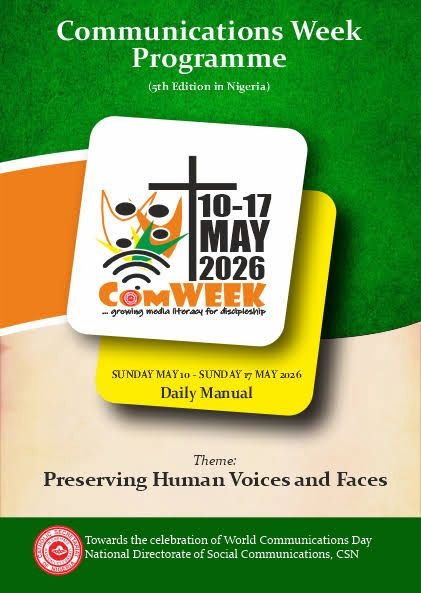
Today, Sunday, May 17, 2026, marks the end of the week-long celebration held annually on the 7th Sunday of Easter. This year, the 60th World Day of Social Communications, Pope Leo XIV, in his message, highlighted the need to preserve human voices and faces. This theme resonates with journalists, media professionals, and digital creators, emphasizing the necessity of protecting the voices and human faces of communication.
In a world where speed is rewarded over truth, going viral over wisdom, and performance over authenticity, humanity risks being reduced to mere machines. Human capacities are increasingly substituted with artificial intelligence, where voices are initiated, images and faces are generated, and compelling arguments are projected at a fast pace. These techno-based initiatives exploit our need for relationships, leading not only to painful consequences in the lives of individuals but also damaging the social, cultural, and political fabrics of society, concerns that the Holy Father, Pope Leo XIV, articulated in his message this year.
These happenstances affect us directly, leaving it challenging to identify the human aspect as human voices and faces become subsumed. Consequently, human presence becomes a choice issue, lurking in the dilemma of being or not being. Confronted by these modern communication challenges, it becomes pertinent to consider the possibilities of fruitfully navigating this scenario while avoiding a superficial attitude that compromises the essence of being and, in turn, considering an opening to an alliance adorned with the triple choices of responsibility, cooperation, and education.
Despite these many challenges, our voices and faces remain significant; every message stems from a person, not merely a robot governed by algorithms or statistics. Our faces reflect our human dignity, while our voices project our identity. When communication loses sight of the human face, cruelty, misinformation, and indifference become normalized. Communication is not merely technologically oriented but needs an anthropological approach. While we communicate this year, let us always remember that the voice of man and the face of man still matter.
To all communicators, the pope’s message is both an encouragement and a warning. Our ultimate goal should always be the pursuit of truth, with a commitment to uphold human dignity in the work and to ensure that voices are always given, more so to the vulnerable. This is increasingly paramount as AI-generated content forms a threat through the rise of fake voices, manipulated videos, and synthetic identities, blurring the line between truth and deception. To foster a better alliance, responsibility, cooperation, and education should be adopted.
May we remain resolute in communicating the truth of the gospel to the hearts of many, allowing our voices, faces, and hearts to be continually lifted to the Lord, who is the truth himself.