- Likens It to Tower of Babel
- Attracts Global Reactions
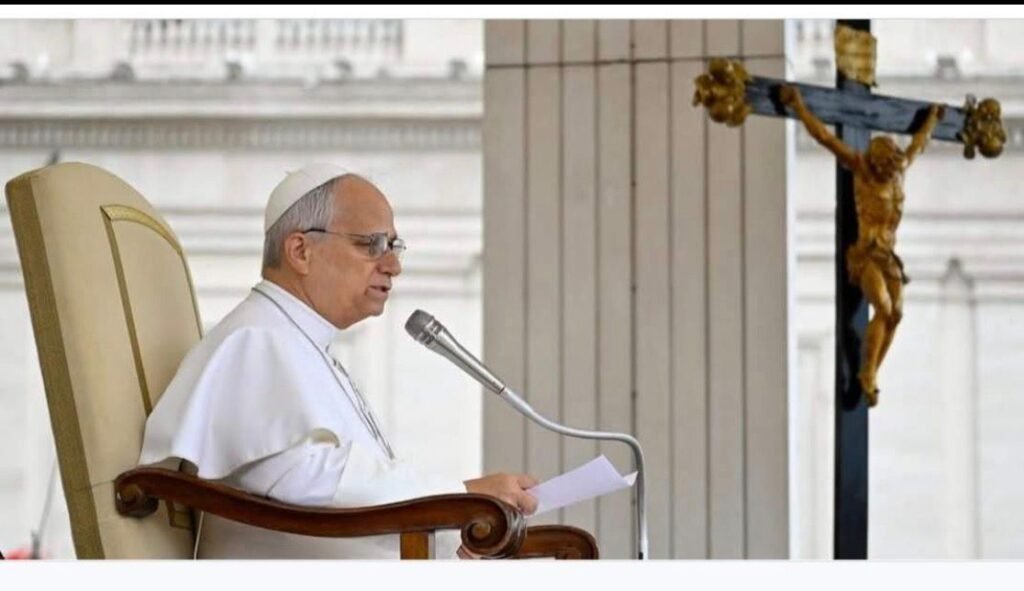
His Holiness Pope Leo XIV is not relenting in his condemnation of, and indisposition to, the unwholesome application of Artificial Intelligence (AI) in human endeavors.
In his first encyclical as the Bishop of Rome, titled Magnifica Humanitas, the Pope hits hard on the global phenomenon, which he likened to Tower of Babel, in the Book of Genesis Chapter 11 of the Old Testament in the Bible, which was humanity’s desire to usurp God’s sovereignty by relying entirely on human effort, technology, and intellect. God intervened to prevent humanity’s unchecked pride and self-glorification.
Magnifica Humanitas, according to the Holy Father, is about safeguarding the human person in the time of artificial intelligence. He appeals for the safeguarding of humanity, promotion of truth, dignity of work, social justice, and peace.
To reinforce his position in the letter published on Monday, May 25, 2026, he explained that “humanity, created by God in all its grandeur, is today facing pivotal choices: either to construct a new Tower of Babel or to build the city in which God and humanity dwell together.”
Pope Leo made it clear that Magnifica Humanitas is not against technology or innovations but averse to their unwholesome applications. According to him, Magnifica Humanitas has an underlying premise: technology is not ”a force antagonistic to humanity’’ nor is it inherently evil.’’
However, “technology is never neutral, because it takes on the characteristics of those who devise, finance, regulate, and use it.” He therefore appeals for people to build “for the common good” ’and to “remain human,” following a courageous mentality of shared responsibility and communion, so that the world will come to recognize the human heart as the place where God desires to dwell.
The Holy Father insists on the need to ensure that technologies are not concentrated in the hands of very few people, thereby widening the gap between those included and those excluded from the digital revolution.
It is worthy to note that, for ages, the Catholic Church, through the direction of the popes and inspiration of the Holy Spirit, has been playing a crucial role in fulfilling the mandate of social engagements for safeguarding humanity, promoting truth, dignity of work, social justice, and peace.
For instance, in the late 19th and 20th centuries, Pope Leo XIII’s epoch-making social encyclical, Rerum Novarum of 1891, became the bedrock of the International Labor Organization (ILO) reform agenda for workers’ welfare. The Catholic Church has also been at the forefront in helping to shape global human development, promoting human dignity, social justice, and shared prosperity. This new encyclical of Pope Leo XIV comes at the 135th anniversary of the promulgation of Pope Leo XIII’s Rerum Novarum
The release of this new encyclical, Magnifica Humanitas, has drawn strong reactions across the globe regarding the ethics of the digital age. Early response to the document presents a sharp split; while tech innovators and free-market advocates express skepticism, religious and social leaders have praised it as a landmark development in Catholic Social Teaching.
Across Europe, North America, and Africa, church leaders have praised the pope’s emphasis on human dignity, transparency, and ethical governance of artificial intelligence. Media analysts have also noted that the encyclical of the Pope demands that technology effectively serve human dignity rather than corporate power.
The Jesuit community commented specifically on the Pope’s call for humanity to become “artisans of hope” against the threat of mass surveillance, algorithmic manipulation, and isolation, which becomes more pertinent in this age. They strongly agreed with the encyclical’s assertion that no computational system or algorithm can replace the human conscience, genuine relationships, or the sacred value of the human face. Furthermore, the Pope’s call to “disarm” artificial intelligence, particularly in warfare and autonomous weapons systems, was emphasized as a critical necessity.
In Africa, the document is celebrated as a prophetic landmark in Catholic social teaching, offering a timely roadmap for societies facing widening inequality, technological dependence, and moral uncertainty. Bishop Emmanuel Badejo of the Catholic Diocese of Oyo described the encyclical as “a light at first sight,” showcasing the readiness of the Church to apply Gospel values in addressing the modern realities of artificial intelligence, robotics, and digital technologies. Similarly, Fr. Stan Chu Ilo of DePaul University, Chicago, and also the coordinating servant of the Pan-African Catholic Theology and Pastoral Network (PACTPAN), described the encyclical’s pastoral, prophetic, theological, and social depth. He stated that the Pope, by utilizing two biblical frameworks, leaves humanity with the moral choice of either pursuing idolatrous power like the builders of the Tower of Babel, constructing a world without God and a world lacking affective, relational, moral, and spiritual depth, or choosing to build a better world from the wounds of history and the ruins of war through a social justice approach that places the common good of all peoples and all creation at the center of integral human development and the rebuilding of our fractured world.
While many ethicists laud the document as one of the strongest interventions for AI regulation, responses from tech specialists are divided; some welcomed its focus on human-centered innovation, while others argued that its cautious tone lacks specific policy measures, suggesting that it will not be deeply impactful in curbing the pursuit of AI by tech elites.
This encyclical remains a groundbreaking one that posits a significant challenge to the age in the struggles of safeguarding humanity.